
The G‑Point of No Return
When the trumpets fall silent!
Is Your Hard Drive Really That Tough?
Strength limits, military standards, and the eggshell effect!
We got together and decided to dig into the research and docs… And finally measure that very G‑point of no return! The point at which it's usually pointless to talk about data recovery chances – but you can still dream!
Why are you so puffed up?!
I'm like this all the time and nothing happens!
Get to the point!
Can your drive actually burst?
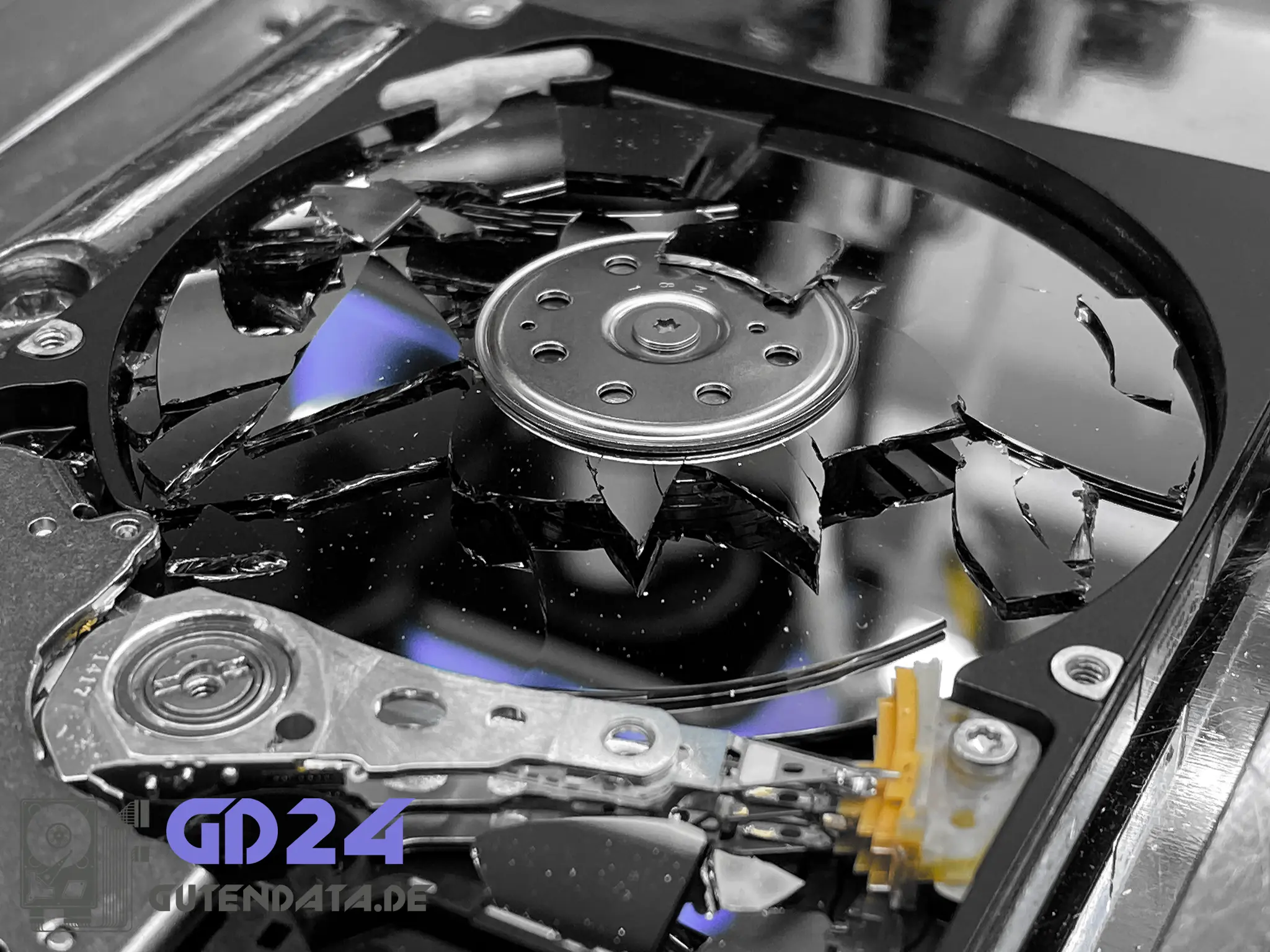
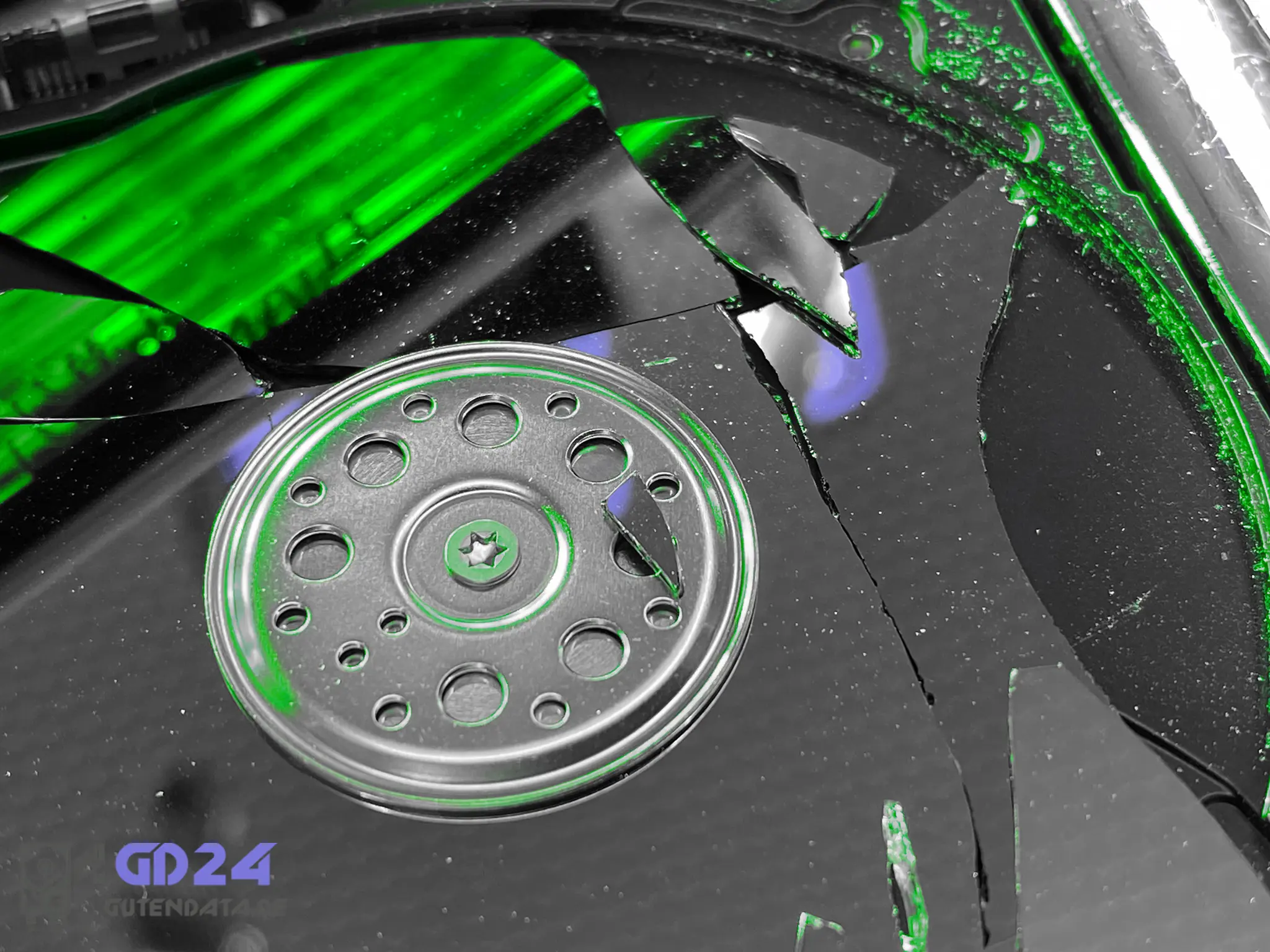
Short answer: If it's a 2.5-inch drive – yes, it can! Just like your ceramic knife that fell off the table last week.
The platters of most 2.5-inch drives are made of special glass-ceramic substrate. They're quite rigid:
- Vickers hardness (HV): 520–700
- Knoop hardness (HK): 600–650
- Nanohardness (Berkovich indenter): 7–7.5 GPa
For comparison, your zirconia ceramic knife is harder: 1100–1250 HV (1000–1200 HK, 11–13 GPa) – but that's not the point. Thanks to these properties, platters are thin, rigid, and have a low coefficient of thermal expansion. This is the perfect substrate for our "layer cake," which later becomes either a storage vault or a tomb for your data.
Anatomy of fragility:
What do these numbers mean?
Before we talk about drops, let's sort out the terminology. The internet often confuses hardness, rigidity, and impact strength.
- Hardness is a material's resistance to scratches and indentation. That's what we measured in HV and GPa above. Glass-ceramics are hard, but not as hard as a ceramic knife.
- Rigidity (shear modulus) is resistance to deformation (twisting, shearing). And here our platters shine: their shear modulus is 26–32 GPa.
Important: This is not hardness but rigidity. For comparison: aluminium has a shear modulus of ~26 GPa, and steel ~80 GPa. So our platters are as rigid as aluminium – but as brittle as glass. It's exactly this combination – rigid plus brittle – that makes them an ideal but dangerous base for storage.
Glass-ceramics lead in hardness, thermal stability, and low weight – but lag behind metals only in impact toughness (brittleness).
You won't find a clearer chart. The larger the shape area, the better the combination of substrate properties. Glass-ceramics offer a balanced profile with an emphasis on hardness and thermal stability; aluminium is light and ductile but soft; steel is rigid and ductile but heavy.
Fun fact: In glass manufacturers' patents (e.g. HOYA) the concept of "brittleness index" (B = Hv / Kc) is used. It shows that a good substrate needs not only high scratch resistance (Hv) but also high fracture toughness (Kc) – the ability not to crack! Ideally, the brittleness index should be ≤ 12 µm⁻¹/² in a wet environment and ≤ 7 µm⁻¹/² in a dry one. It's exactly this combination that delivers those very 300–400 G that the platter itself can withstand – but not the whole assembled drive.
By the way, other manufacturers reach similar conclusions. For example, in the patents of Asahi Glass Company (AGC) – the main competitor of HOYA in the glass substrate market. Attention is also paid to the Young's modulus at a level of at least 81 GPa, which confirms the need for high rigidity to resist deformations during rotation. In addition, AGC focuses on manufacturability and laser surface treatment to improve head glide.
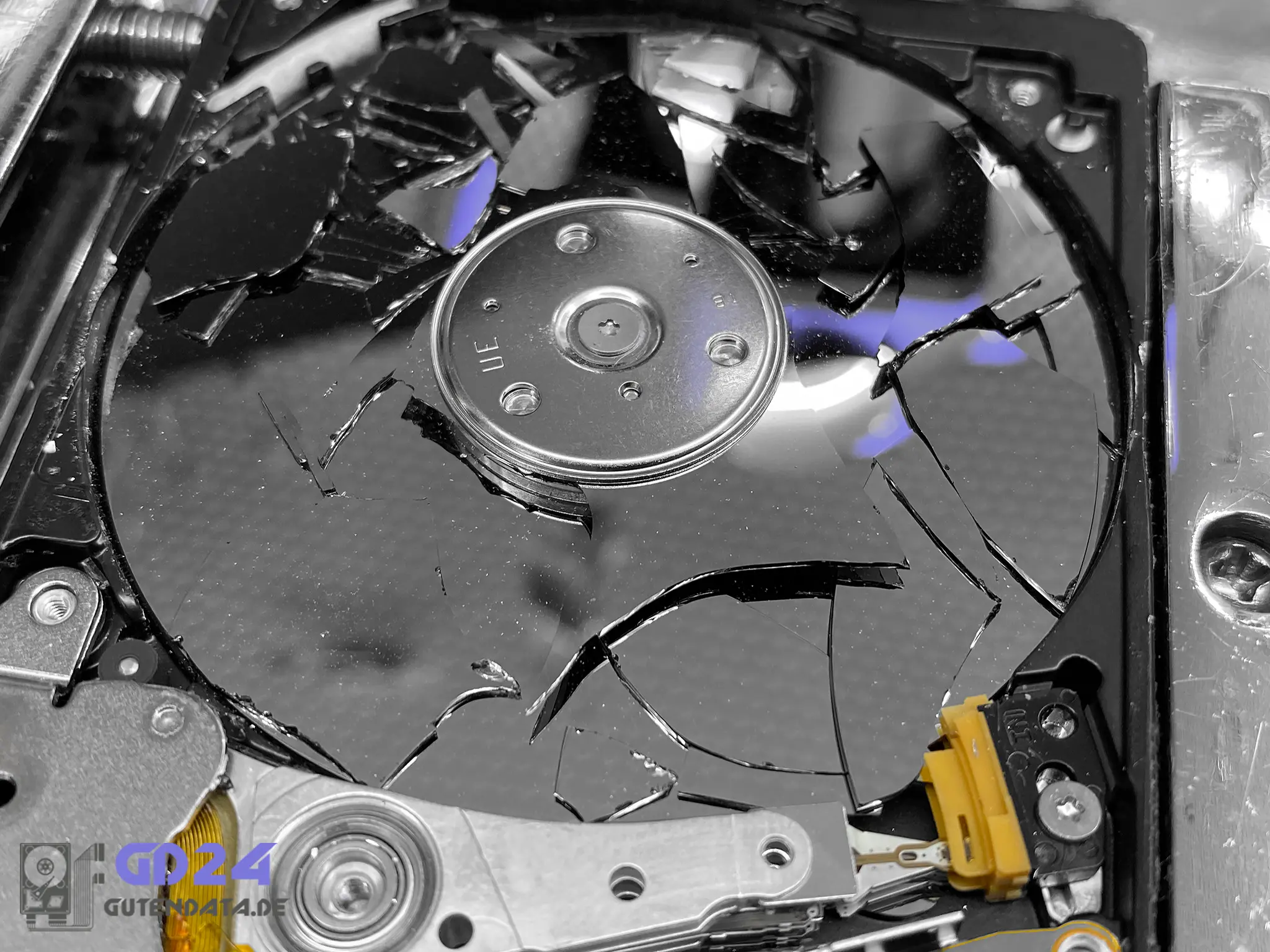
The real limit:
How many G can a drive survive?
Now let's get to the most interesting part – shock loads. Forget about GPa – here we're talking about G (multiples of free-fall acceleration). It's the g-force a drive experiences on impact. There are three important levels that must not be confused:
From G to centimetres: the full picture
Equivalent drop height (flat impact)
The G scale – shock overload. The Δt scale – pulse duration. The shorter the impact (fewer ms), the higher the overload.
How to read the chart: top bars – shock resistance in G, middle scale – the relation between G and pulse duration (Δt), bottom table – the equivalent drop height for different surfaces. The shorter the impact (fewer ms), the higher the overload.
Important: these numbers are for an ideal flat impact.
In reality the drive falls on its edge or corner, and the destructive load increases many times over.
Pay attention to the proportions. The three shock levels (300–400, 800–1000, and 60–70 G) look like big numbers, but on a 3000 G scale they occupy only 13%, 33%, and 2% respectively. Everything else to the right (1000–3000 G) is the "red zone" where the drive is guaranteed to fail.
Why pulse duration (Δt) matters. The shock overload is inversely proportional to deceleration time: the shorter the impact (fewer milliseconds), the higher the G. At 0.67 ms even 2000 G becomes a reality – and that's fatal for any drive.
Relation to centimetres. The bottom table translates abstract G into understandable centimetres for different surfaces. The same drive can break when dropped from 1 cm onto concrete, but survive a fall from 15 cm onto carpet – it all depends on how the surface stretches the impact over time.
Why it works that way. Concrete gives Δt ≈ 0.5–1 ms (hard impact), while carpet gives Δt ≈ 3–5 ms (soft impact). That's a 5-fold difference in time – and a 5-fold difference in overload.
Summary: shock resistance isn't just a number in G. It's the product of drop height, surface rigidity, and the state of the drive (on/off). That's why manufacturers specify pulse duration in datasheets – without it, the numbers in G are meaningless.
Military standards:
The illusion of protection?!
But what about the coveted MIL-STD-810G labels on the boxes? What do they mean?! This isn't a "Pentagon certificate" but a testing guide. The manufacturer chooses which of the 29 methods to apply and how to interpret the results. The most popular MIL-STD-810G test, Method 516.6, Procedure IV (Transit Drop):
- The drive, powered off, is dropped 26 times onto 5 cm plywood placed on concrete.
- Drop height – 122 cm.
Irony: Manufacturers often write "tested according to the standard", not "certified". Because real military certification for consumer drives doesn't exist. It's like a slogan painted on a fence – readable, but not to be taken as truth.
What about the rest of the world?! As we've found, MIL-STD-810 is a US standard. But maybe Europe, China, or Russia have mandatory shock resistance requirements for drives? Maybe somewhere manufacturers are forced to make drives tougher?
All electronics requirements worldwide fall into three levels, and only one of them even mentions shocks:
The most important thing here is not getting an electric shock! These are mandatory requirements. Without them, a drive won't be allowed on the market!
Takeaway for the reader: The state cares that the drive doesn't shock you and doesn't interfere with other devices.
Nobody cares whether it breaks when dropped.
What matters here is not poisoning the environment! Without compliance with these norms, a drive won't be sold.
Takeaway for the reader: The state cares that the drive doesn't poison nature with lead and mercury.
Whether it breaks when dropped is still no one's concern.
How to test – but voluntary and not guaranteed! The manufacturer decides whether to test or not.
Takeaway for the reader: Even where shocks are mentioned, it's a methodology, not a guarantee.
A manufacturer may use it, or may not.
That's why boxes say "tested to MIL-STD-810G", not "certified".
The main paradox: No government in the world obliges manufacturers to make hard drives shock-resistant.
All mandatory standards concern safety and ecology. And shock resistance is a voluntary manufacturer initiative!
That's why real shock resistance figures (60–70 G powered on, 800–1000 G powered off) appear only in the
datasheets of Seagate, Western Digital, and Toshiba. No government standard sets such figures.
The eggshell effect:
Why armour doesn't save you?
Now for the main paradox. The top layer of the platter is DLC (diamond-like carbon). Its hardness reaches 40–60 GPa (almost like diamond!). On top of it a PFPE (perfluoropolyether) lubricant is applied.
Question: If the platter is covered with almost diamond armour, why does it break?
Answer: That's the eggshell effect.
- The DLC layer protects against scratches and wear – it stops the head from scratching the magnetic layer.
- But it doesn't absorb impact energy. On a fall, all the force hits the brittle glass substrate. If the substrate cracks, the DLC film simply follows its relief and cracks with it.
The DLC layer thickness is only 4–30 nanometres. That's thousands of times thinner than a hair. Like an eggshell: hard, but easy to crush.
Instrumental confirmation:
The analytical equipment manufacturer Thermo Fisher Scientific published a technical note in which a hard disk platter was analysed using XPS (X-ray photoelectron spectroscopy). 230 etching cycles
were performed and 230 survey spectra were captured, allowing 14 elements in 7 main components to be identified. The structure was confirmed: glass substrate → buffer layer (Ni, Ta) → magnetic layers → protective carbon layer → lubricant.
ULVAC-PHI also published XPS profiles showing ultra-thin protective layers (a few nanometres thick). And Hiden Analytical uses SNMS (neutral particle mass spectrometry) for high-depth-resolution analysis of the layered structure.
This proves once again: the DLC layer and lubricant are not fiction but real layers just a few nanometres thick. And it's precisely their thinness that makes them helpless against impacts.
XPS atomic-percent profile
Reconstruction of Figure 4 from Thermo Fisher Application Note AN0124
What the chart shows: layer-by-layer composition of a hard disk, obtained by XPS. Each line is a separate chemical element. The top 10 nm – lubricant and DLC coating, 20–40 nm – magnetic layer, 50–80 nm – Ni/Ta buffer, and deeper than 100 nm – the glass substrate.
PFPE lubricant (perfluoropolyether, ~10–12 nm). An ultra-thin layer (1–2 nm) of fluorine-containing polymer on top of the DLC. It reduces friction between the head and the disk. PFPE is thermally stable up to ~170 °C. Above that, it starts to decompose. On contact with Al₂O₃ (from the slider material), decomposition accelerates: the oxide catalyses the breakdown of C-O bonds in the terminal groups of the molecules. The presence of oxygen does not affect the decomposition rate.
DLC coating (diamond-like carbon, ~0–10 nm). This is the "armour" of the disk – an amorphous carbon film with high hardness (up to 40–60 GPa). It protects the magnetic layer from scratches and corrosion, but it's brittle and doesn't absorb impact energy. Its thickness is only a few nanometres, so even a microscopic scratch can become a fracture point.
Magnetic layer (12–40 nm). Cobalt (Co), platinum (Pt), chromium (Cr). Your data is stored here.
Ni/Ta buffer (40–90 nm). Nickel (Ni) and tantalum (Ta). Needed so the glass structure doesn't affect the crystalline orientation of the magnetic layers.
Glass (90+ nm). Silicon (Si), aluminium (Al), sodium (Na), potassium (K), zirconium (Zr). This is the substrate – the brittle base of the whole "pie".
Important: these are data for a 3.5-inch drive with a glass substrate. In 2.5-inch models the substrate is glass-ceramic, but the principle is the same.
Now imagine: this whole complex structure less than 100 nanometres thick rests on fragile glass. Like an egg: the shell is hard, but the contents are fragile. The impact destroys not the DLC film, but the glass beneath it.
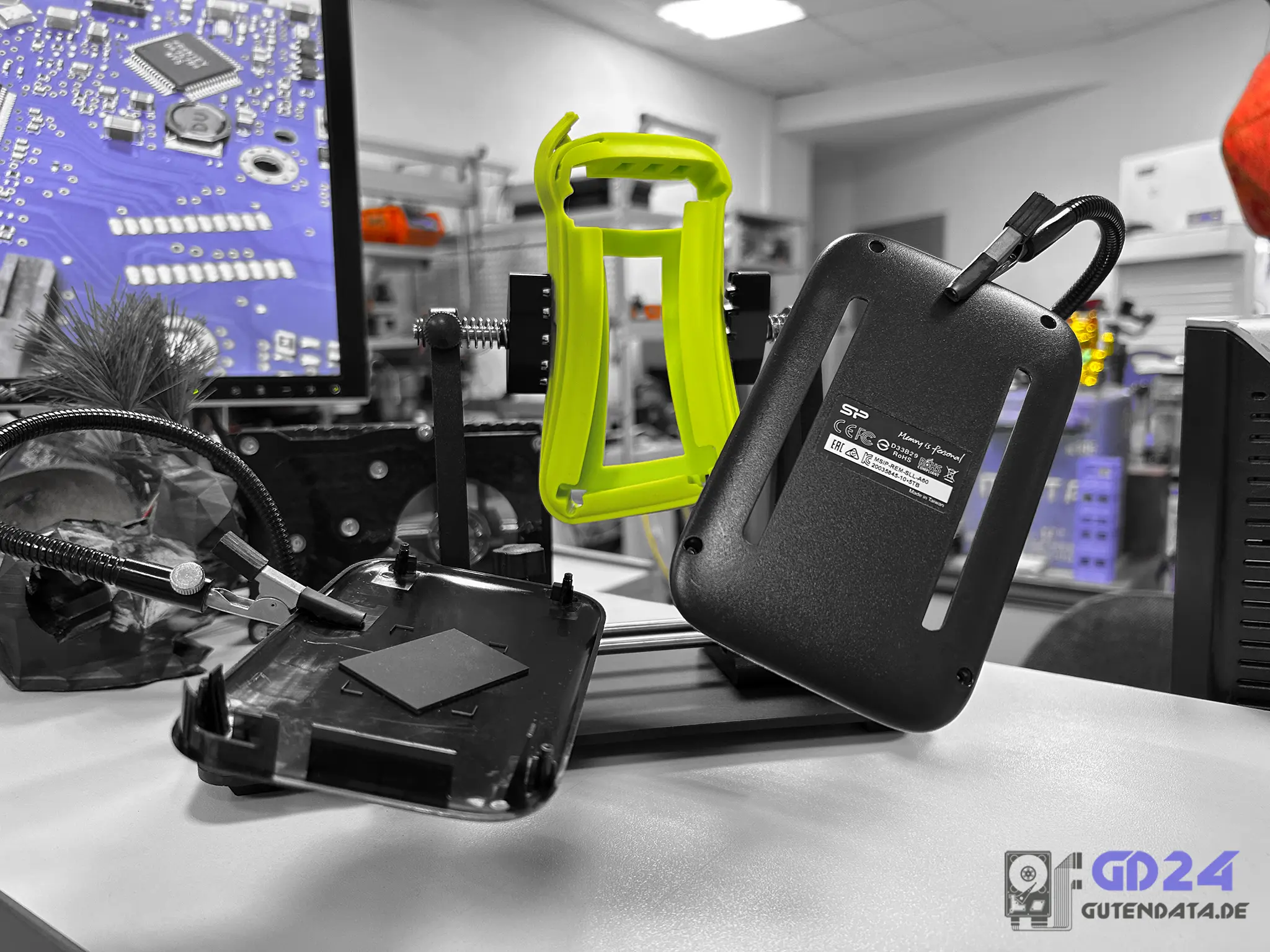
The real deal:
Enclosures and accelerometers
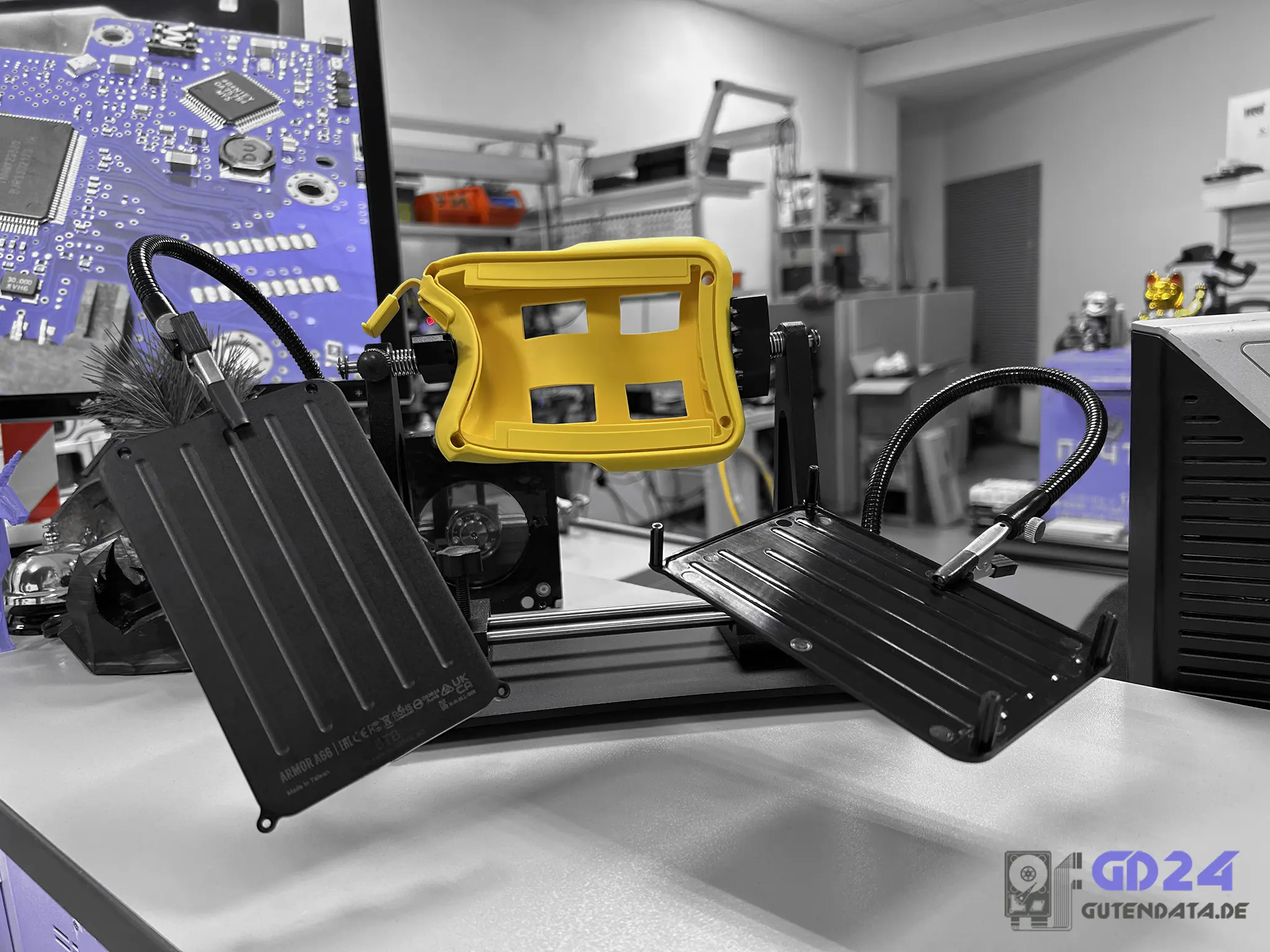
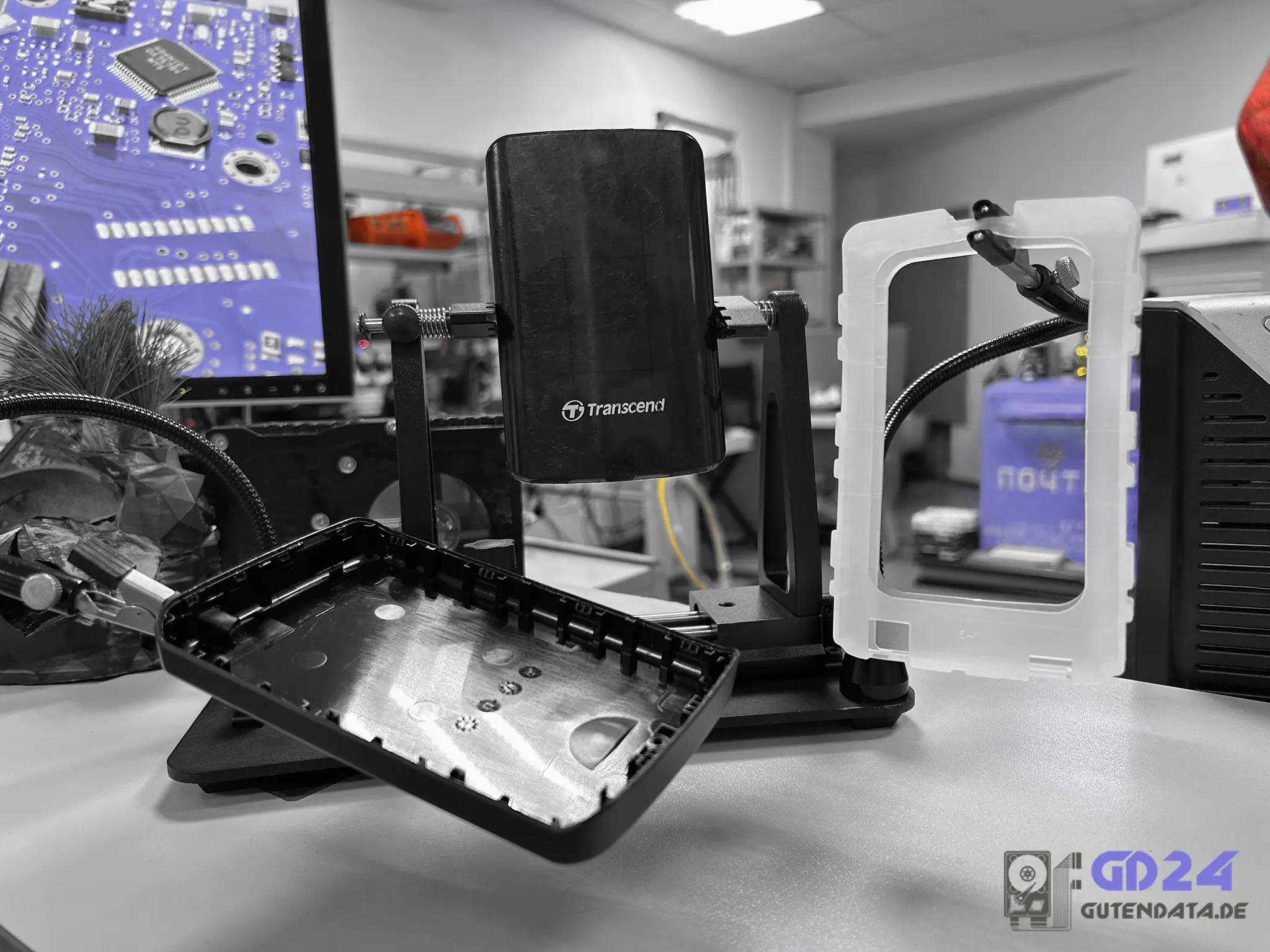
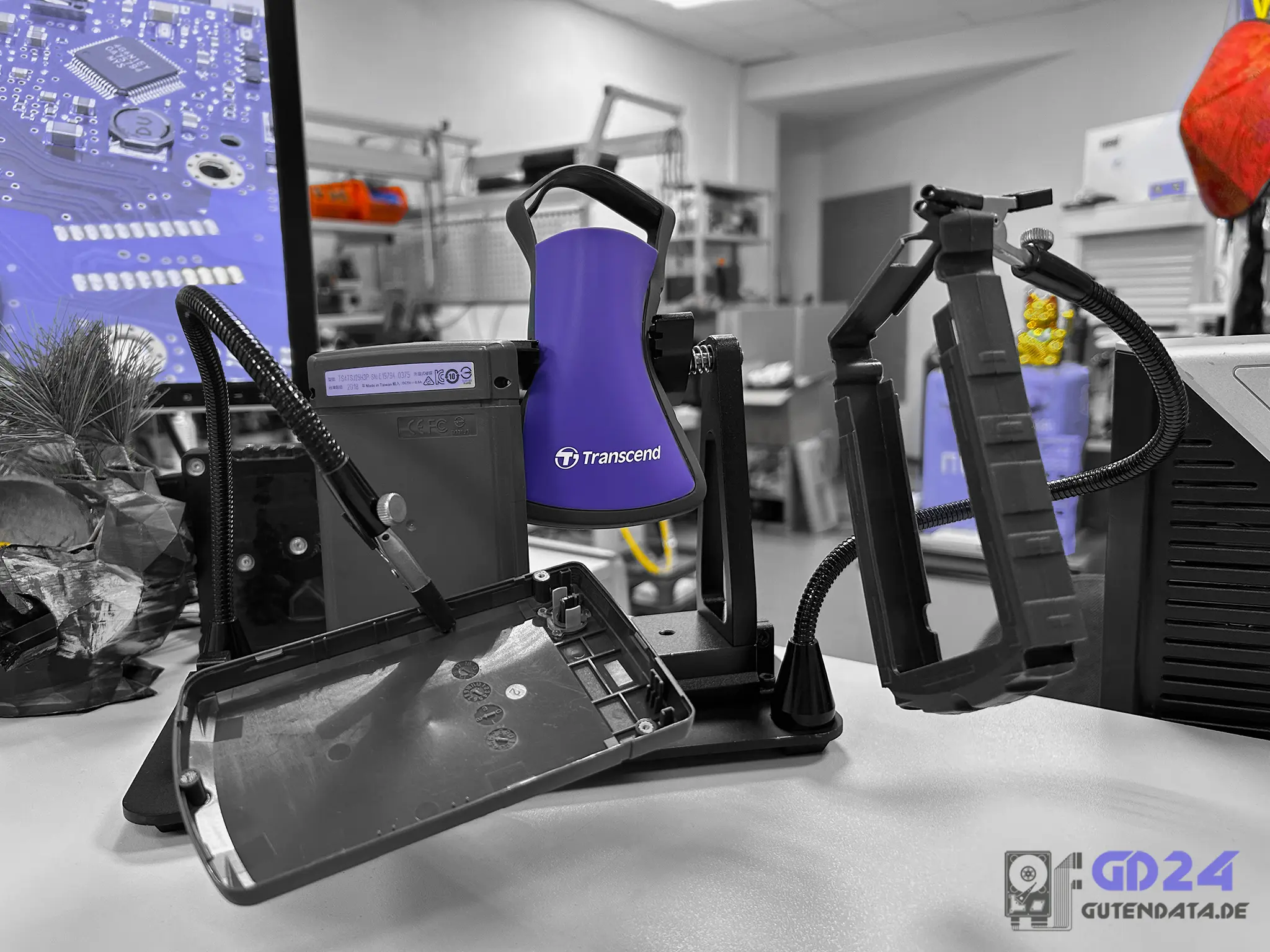
External drive manufacturers (ADATA, LaCie, Transcend) try to save the day with:
- Silicone enclosures – they dampen the impact by increasing its pulse duration (Δt).
- Accelerometer sensors – they "park" the heads when free fall is detected.
But even this is no panacea. Manufacturers clearly state in the warranty:
"The warranty does not cover damage resulting from an accident, misuse, negligent handling, mechanical impact (shocks, drops)..."
So if you dropped it – you're on your own, Pinocchio.
Summary table: who promises what
What this means for you: even the most protected enclosure won't save you from a corner impact or a drop while powered on. It's insurance against accidents, not a bulletproof vest.
The bitter taste of wine:
Myths and facts
Summary: shock resistance isn't just a number in G. It's the product of drop height, surface rigidity, and drive state. That's why manufacturers specify pulse duration in datasheets – without it, numbers in G are meaningless.
Conclusion:
Miracles don't happen!
Let's sum up. Hardness numbers, shear moduli, and military standards are interesting, but in practice it all comes down to simple rules:
- Take care of your drive. The most reliable drive is the one lying on a table that nobody touches.
- Don't test the protection for strength. Manufacturers test under ideal conditions – your life isn't a lab.
- Make backups. Even the most protected drive can die from a 10 cm fall if it hits a corner. A backup will save your data.
- Get a casing with an accelerometer, but don't believe in miracles. It's extra insurance, not a bulletproof vest.
- Don't drop a powered-on drive. Not even on carpet. Better to power it off first, then move it.
The main law of gravity for hard drives: It always works. Your job is to make sure it never gets the chance.
Sources and materials:
Where we got this from
The article is based on patents, scientific publications, standards, and manufacturers' datasheets. Full list below.
Patents from glass substrate manufacturers
- HOYA US 8,697,592 B2 – Glass Substrate for Information Recording Medium
- Asahi Glass US 5,861,196 A – Laser Texturing a Glass or Glass-Ceramic Substrate
Scientific publications and technical notes
- Spectroscopy Online (2016) – Compositional Depth Profiling of Hard Disks by GD-AES
- Thermo Fisher Scientific – XPS Analysis of a Hard Disk Platter (AN0124)
- ULVAC-PHI – Magnetic Media Depth Profiles
- Hiden Analytical – SNMS Depth Profiling of Layered Structures
International and national standards
- USA (military) – MIL-STD-810G, Method 516.6
- USA (FCC) – FCC Part 15
- USA (encryption) – FIPS 140-2 / FIPS 140-3
- USA (sanitisation) – NIST SP 800-88
- USA (testing) – ASTM F2592
- Russia / EAEU – TR CU 004/2011, TR CU 020/2011, TR EAEU 037/2016
- Russia – GOST 27830-88, GOST R 59299-2020
- China – GB/T 12628-2008
- Japan – JIS K6253
- Europe – RoHS 2011/65/EU, CE (LVD, EMC)
HDD manufacturers' datasheets
- Seagate – Product Manuals (Operating / Non-Operating Shock)
- Western Digital – Product Specifications
- Toshiba – HDD Datasheets
External drive manufacturers' datasheets
Important: all data in this article comes from open sources. We did not conduct our own tests, but analysed what manufacturers, laboratories, and patent offices have published.
Frequently asked questions:
Briefly, the essentials
Lab Opening Hours
Looks like we have a lunch break!
Our Locations
Central office and drop‑off points.